Selling White Australia
Or, why multiculturalism cannot redeem us
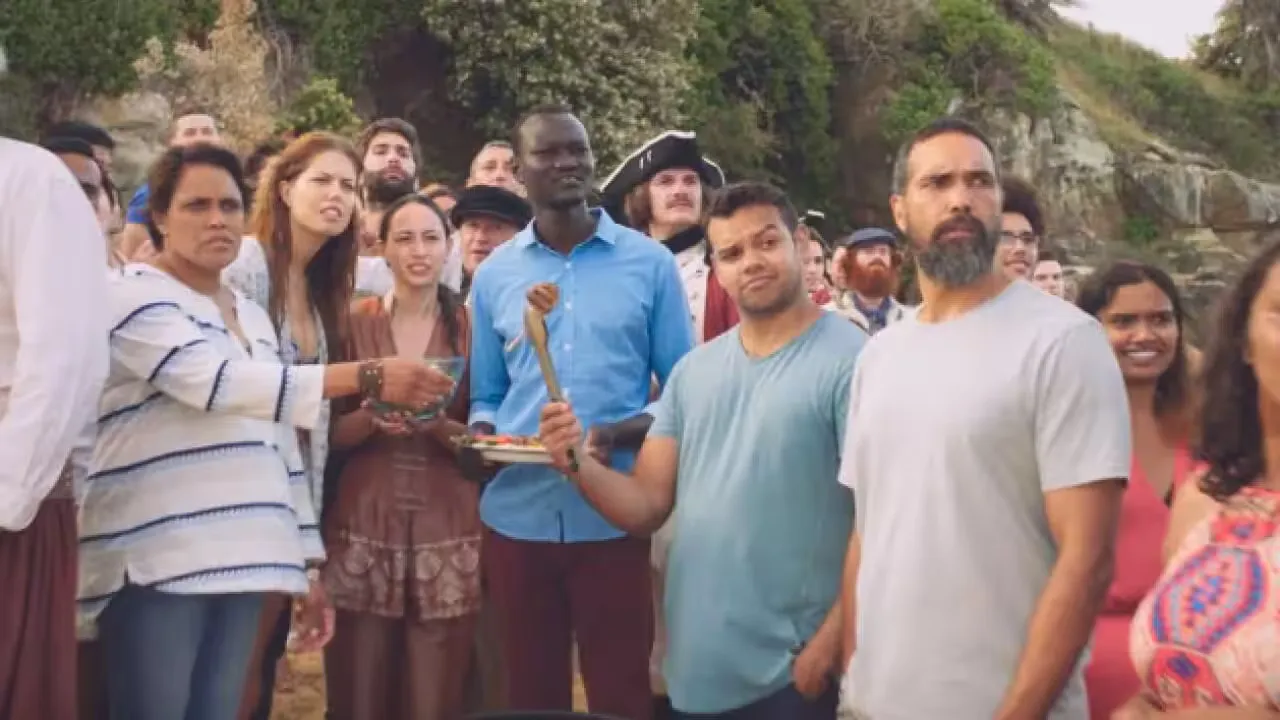
Every year, Meat and Livestock Australia puts out a short film that eventually tells you to eat lamb. It’s one of the most celebrated cultural events in our national calendar, receiving coverage by the national broadcaster and broadsheets.
It’s awesome, and not just because it’s a demonic product of nationalism and capitalism. It’s a deeply awkward display of what nationalism needs to be in 21st Century so-called Australia.
If you’re going to use nationalism to sell something, in this case the factory-farmed flesh of 6-month-old lambs, you need to make it palatable. You need to pretty up the colonial project with some multiculturalism. Add some jokes about Aussie culture, like the classic peeves of charging for tomato sauce or being a dobber. You can even showcase First Nations when talking about how brilliant this nation is, that stole their land, languages and children.
It’s fun to pick on ads but it’s only doing what we, as an audience and a country, expect in these civilised times. The lamb ads aren’t proposing a vision of Australianness, they’re reacting to perceived expectations and values in the community. And if we’re going to buy into Australia, we need a potent mix of self-delusion, historical distance and imagined reconciliation in order to still feel good about it.
Because we live in a post-satire world, this is explicitly hammered home in the way Australia Day gets marketed to us. Women in hijabs holding Australian flags next to white guys with Southern Cross tattoos. All standing around a barbecue eating lamb. The message is clear, “you too can join the colonial project, no matter your background!”. Yes, we are gonna wring the soil for every ounce of coal, uranium and iron we can take but we all need to feel like one team in the process.
It doesn’t help that we’ve built psychic national monuments out of the meager racial gains we’ve made. Every school student learns about how we put aside our prejudices, and sacrificed our long-held White Australia policy so we could import more skilled migrants. That’s right - the law changed not because Australians got nicer, but (a) because capital demanded it, and (b) the threat to the wages of the (unionized) (white) working class was sufficiently diminished in the post-war boom.
To be explicit, changing the diversity metrics of Australian society, or even its leadership, cannot meaningfully change the behaviour of the Australian economy. To demonstrate, let’s try a thought experiment: how multicultural must our politicians be, for example, for Aboriginal reparations to pass? Or, more modestly, for Rio Tinto to be nationalised after wantonly destroying a cultural site ten times older than Stonehenge?
It’s a nonsensical question. The ruthless logic of the system operates completely tangentially to concepts like diversity and inclusion, which make them the perfect focal points of a harmless discourse.
Nonetheless, we have been trained to hypervigilance on diversity markers like “Women in Leadership” or “CALD representation”. It’s not that these are bad per se, it’s that they’re all we’ve got, and unable to change the system on any fundamental level. Any meaningful conversation around race is gonna have to talk about changing the dynamics of the Australian economy, and you can’t do that without talking about class.
In fact, it’s a crowning achievement of Australian capitalism that it’s been able to assert the same class structure over a more flexible, multicultural society. Don’t get me wrong, we still use migrants as cheap, disposable labour - we Aussies ain’t gonna pick our own fruit. But that can no longer be explicitly racially coded since so much of the community isn’t white. The Liberals figured this out in the 90s, and it’s win-win-win.
- It’s great for capital because it simultaneously brings some elasticity to the workforce and adds some precarity to uppity domestic workers,
- Patient, law-abiding (precarious!) citizens who “came here the right way” get to set themselves apart and opposed to “Unscrupulous” “economic” migrants, and
- There’s that ever-present crotchety demographic who’ll take the opportunity to shit on anyone who isn’t white.
It’s fine for us to talk about it amongst ourselves - class, that is. You and I can speak frankly about the real drivers of social and economic exclusion. We’ll even broadly agree on outcomes. But that conversation isn’t allowed anywhere near HR departments, modern politics, and especially not our lamb ads.